A homeomorphism of the unit ball having no fixed point

Let’s recall Brouwer fixed-point theorem.

Theorem (Brouwer): Every continuous function from a convex compact subset \(K\) of a Euclidean space to \(K\) itself has a fixed point.

We here describe an example of a homeomorphism of the unit ball of a Hilbert space having no fixed point. Let \(E\) be a separable Hilbert space with \((e_n)_{n \in \mathbb{Z}}\) as a Hilbert basis. \(B\) and \(S\) are respectively \(E\) closed unit ball and unit sphere.

There is a unique linear map \(u : E \to E\) for which \(u(e_n)=e_{n+1}\) for all \(n \in \mathbb{Z}\). For \(x = \sum_{n \in \mathbb{Z}} \xi_n e_n \in E\) we have \(u(x)= \sum_{n \in \mathbb{Z}} \xi_n e_{n+1}\). \(u\) is isometric as \[\Vert u(x) \Vert^2 = \sum_{n \in \mathbb{Z}} \vert \xi_n \vert^2 = \Vert x \Vert^2\] hence one-to-one. \(u\) is also onto as for \(x = \sum_{n \in \mathbb{Z}} \xi_n e_n \in E\), \(\sum_{n \in \mathbb{Z}} \xi_n e_{n-1} \in E\) is an inverse image of \(x\). Finally \(u\) is an homeomorphism. Continue reading A homeomorphism of the unit ball having no fixed point →

Counterexamples around differentiation of sequences of functions

We consider here sequences of real functions defined on a closed interval. Following theorem is the main one regarding the differentiation of the limit.

Theorem: Suppose \((f_n)\) is a sequence of functions, differentiable on \([a,b]\) and such that \((f_n(x_0))\) converges for some point \(x_0 \in [a,b]\). If \((f_n^\prime)\) converges uniformly on \([a,b]\), then \((f_n)\) converges uniformly on \([a,b]\) to a function \(f\) and for all \(x \in [a,b]\) \[f^\prime(x)=\lim\limits_{n \to \infty} f_n^\prime(x)\] What happens if we drop some hypothesis of the theorem? Continue reading Counterexamples around differentiation of sequences of functions →

An infinite group whose proper subgroups are all finite

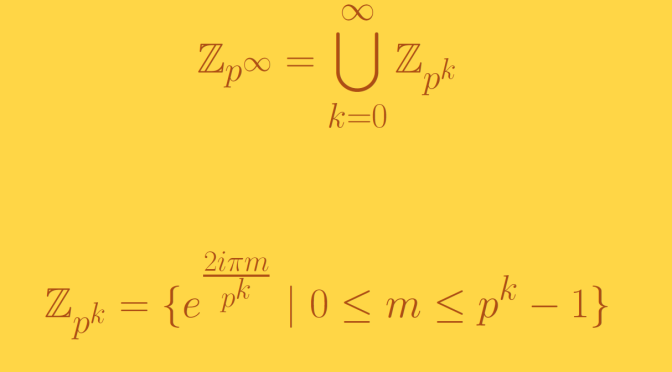
We study some properties of the Prüfer \(p\)-group \(\mathbb{Z}_{p^\infty}\) for a prime number \(p\). The Prüfer \(p\)-group may be identified with the subgroup of the circle group, consisting of all \(p^n\)-th roots of unity as \(n\) ranges over all non-negative integers:
\[\mathbb{Z}_{p^\infty}=\bigcup_{k=0}^\infty \mathbb{Z}_{p^k} \text{ where } \mathbb{Z}_{p^k}= \{e^{\frac{2 i \pi m}{p^k}} \ | \ 0 \le m \le p^k-1\}\]

\(\mathbb{Z}_{p^\infty}\) is a group

First, let’s notice that for \(0 \le m \le n\) integers we have \(\mathbb{Z}_{p^m} \subseteq \mathbb{Z}_{p^n}\) as \(p^m | p^n\). Also for \(m \ge 0\) \(\mathbb{Z}_{p^m}\) is a subgroup of the circle group. We also notice that all elements of \(\mathbb{Z}_{p^\infty}\) have finite orders which are powers of \(p\). Continue reading An infinite group whose proper subgroups are all finite →

Counterexample around Arzela-Ascoli theorem

Let’s recall Arzelà–Ascoli theorem:

Suppose that \(F\) is a Banach space and \(E\) a compact metric space. A subset \(\mathcal{H}\) of the Banach space \(\mathcal{C}_F(E)\) is relatively compact in the topology induced by the uniform norm if and only if it is equicontinuous and and for all \(x \in E\), the set \(\mathcal{H}(x)=\{f(x) \ | \ f \in \mathcal{H}\}\) is relatively compact.

We look here at what happens if we drop the requirement on space \(E\) to be compact and provide a counterexample where the conclusion of Arzelà–Ascoli theorem doesn’t hold anymore.

We take for \(E\) the real interval \([0,+\infty)\) and for all \(n \in \mathbb{N} \setminus \{0\}\) the real function
\[f_n(t)= \sin \sqrt{t+4 n^2 \pi^2}\] We prove that \((f_n)\) is equicontinuous, converges pointwise to \(0\) but is not relatively compact.

According to the mean value theorem, for all \(x,y \in \mathbb{R}\)
\[\vert \sin x – \sin y \vert \le \vert x – y \vert\] Hence for \(n \ge 1\) and \(x,y \in [0,+\infty)\)
\begin{align*}
\vert f_n(x)-f_n(y) \vert &\le \vert \sqrt{x+4 n^2 \pi^2} -\sqrt{y+4 n^2 \pi^2} \vert \\
&= \frac{\vert x – y \vert}{\sqrt{x+4 n^2 \pi^2} +\sqrt{y+4 n^2 \pi^2}} \\
&\le \frac{\vert x – y \vert}{4 \pi}
\end{align*} using multiplication by the conjugate.

Which enables to prove that \((f_n)\) is equicontinuous.

We also have for \(n \ge 1\) and \(x \in [0,+\infty)\)
\begin{align*}
\vert f_n(x) \vert &= \vert f_n(x) – f_n(0) \vert \le \vert \sqrt{x+4 n^2 \pi^2} -\sqrt{4 n^2 \pi^2} \vert \\
&= \frac{\vert x \vert}{\sqrt{x+4 n^2 \pi^2} +\sqrt{4 n^2 \pi^2}} \\
&\le \frac{\vert x \vert}{4 n \pi}
\end{align*}

Hence \((f_n)\) converges pointwise to \(0\) and for \(t \in [0,+\infty), \mathcal{H}(t)=\{f_n(t) \ | \ n \in \mathbb{N} \setminus \{0\}\}\) is relatively compact

Finally we prove that \(\mathcal{H}=\{f_n \ | \ n \in \mathbb{N} \setminus \{0\}\}\) is not relatively compact. While \((f_n)\) converges pointwise to \(0\), \((f_n)\) does not converge uniformly to \(f=0\). Actually for \(n \ge 1\) and \(t_n=\frac{\pi^2}{4} + 2n \pi^2\) we have
\[f_n(t_n)= \sin \sqrt{\frac{\pi^2}{4} + 2n \pi^2 +4 n^2 \pi^2}=\sin \sqrt{\left(\frac{\pi}{2} + 2 n \pi\right)^2}=1\] Consequently for all \(n \ge 1\) \(\Vert f_n – f \Vert_\infty \ge 1\). If \(\mathcal{H}\) was relatively compact, \((f_n)\) would have a convergent subsequence with \(f=0\) for limit. And that cannot be as for all \(n \ge 1\) \(\Vert f_n – f \Vert_\infty \ge 1\).